
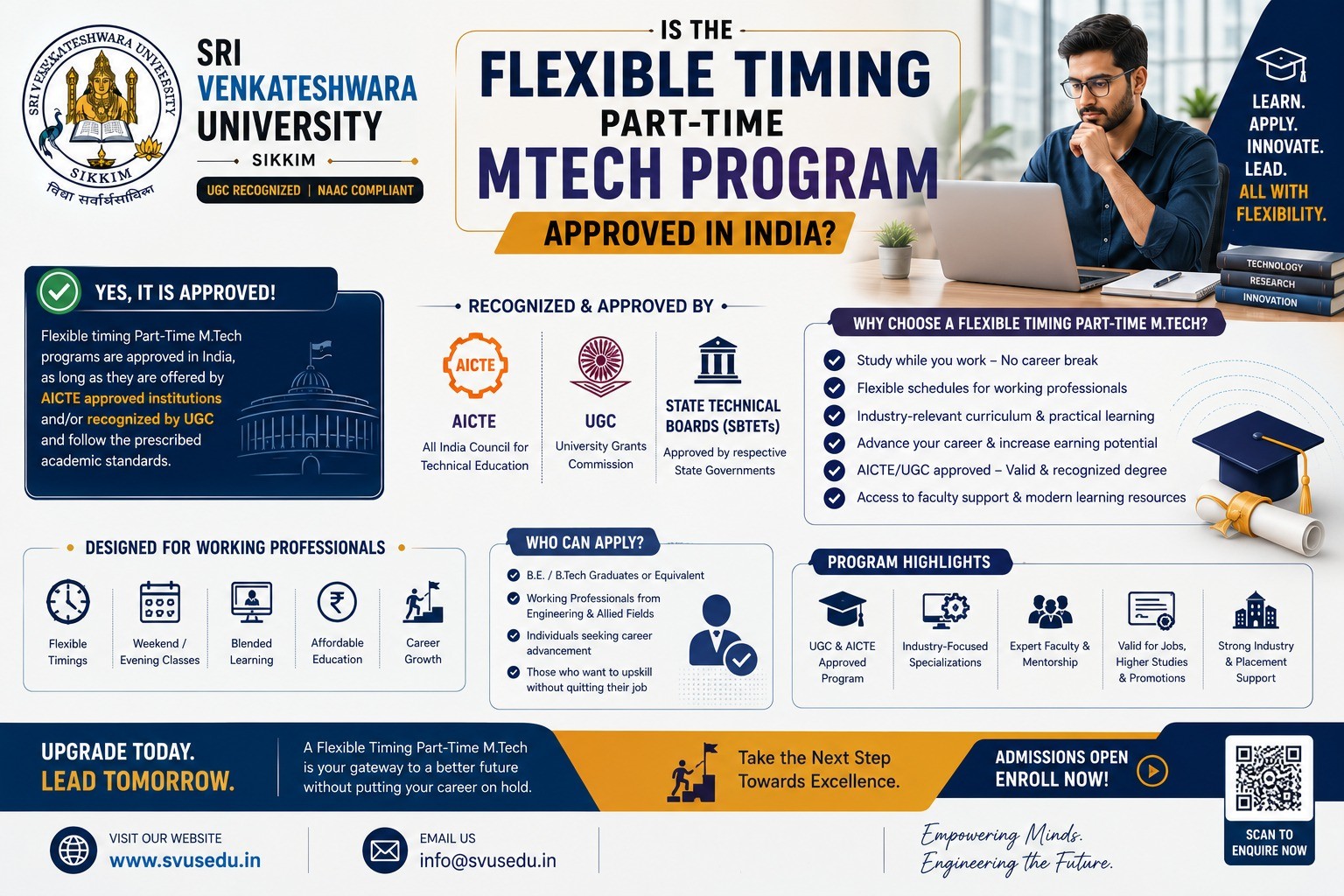
Is the Flexible Timing Part-Time MTech Program Approved in India?
With the increase in demand for upskilled workers in the workplace, corporate managers look for qualified applicants when hiring or promoting staff members. Students and struggling workers are also having trouble finding fulfilling employment. The M.Tech part time course has been accepted by the UGC and AICTE in India after taking into account all of the shortcomings. Let us gain a better understanding of the M.Tech Flexible Timing course.
What is the M.Tech Flexible Timing Program?
The two-year post-graduation M.Tech Flexible Timing program was created to provide students with advanced, specialised, and useful information. The working professional course is renowned for its up-to-date curriculum and methods for improving students' knowledge through seminars, research projects, and practical instruction.
To tackle the current difficulties of engineering problems, the part-time M.Tech flexible time shift course increases the understanding of engineering concepts. Students can concentrate on both new academic chances and new career opportunities because of flexible scheduling.
Is M.Tech Flexible Timing Valid in India?
M.Tech programs with flexible scheduling are legitimate in India and worthwhile for working people. In India, the AICTE and UGC have authorised the M.Tech flexible time program. Candidates can continue working because the program has a flexible timetable. As a result, it is regarded as a convenient part-time M.Tech program for working professionals.
Top College for M.Tech Flexible Timing Program In India
The top M.Tech work-integrated learning program is offered by WILP Sri Venkateshwara University . It lasts two years and is broken up into four semesters. The University Grant Commission (UGC) has given its approval to the program. In order to allow employees to balance their classes with their professional obligations, the university ensures that it will hold sessions on flexible dates, such as weekends, evenings, and public holidays.
Key Attributes of the M.Tech Part-Time Course for Working Professionals
If students enrol on the WILP Sri Venkateshwara University M.Tech flexible timing part time course. They will receive quality education through a Part-Time M.Tech flexible time shift program:
Who Can Enrol on the M.Tech Flexible Timing Program at WILP Sri Venkateshwara University ?
Working professionals who have relevant experience and want to further their knowledge in the same field can enrol in the part-time M.Tech program. The following are WILP Sri Venkateshwara University's eligibility requirements:
Candidates must have work experience in the same sector in addition to the qualifications listed in the previous paragraph. Those who have finished their B.E. or B.Tech professionals in the relevant industry are eligible to apply for the M.Tech Flexible Timing course. To be qualified for the program, one must have at least one year of experience.
No Age Limitation:
WILP Sri Venkateshwara University does not have any age restrictions on program applicants. Therefore, candidates might complete the application if they want to learn new skills.
What Specializations Are Offered at WILP Sri Venkateshwara University for M.Tech Flexible Time Shifts?
The University has introduced the following specialisations to upgrade the learning of working professionals:
These courses are further specialized, like structural engineering or transportation engineering, in the case of civil engineering. Or in the case of VLSI Design or Communication systems in the case of Electronics Engineering
Career Options after M.Tech Part-Time Degree Program
There are many career options for applicants after completing the M.Tech based on their specializations. Here are the most chosen designations mentioned for the reference of the readers, with an average salary:
Job Opportunities
Conclusion
The M.Tech. A flexible timing program for working professionals is open to students who cannot afford regular, traditional M.Tech programs. Students who have a flexible timetable can balance their studies with their employment. Nonetheless, candidates must apply to a university that has been recognised for the program.